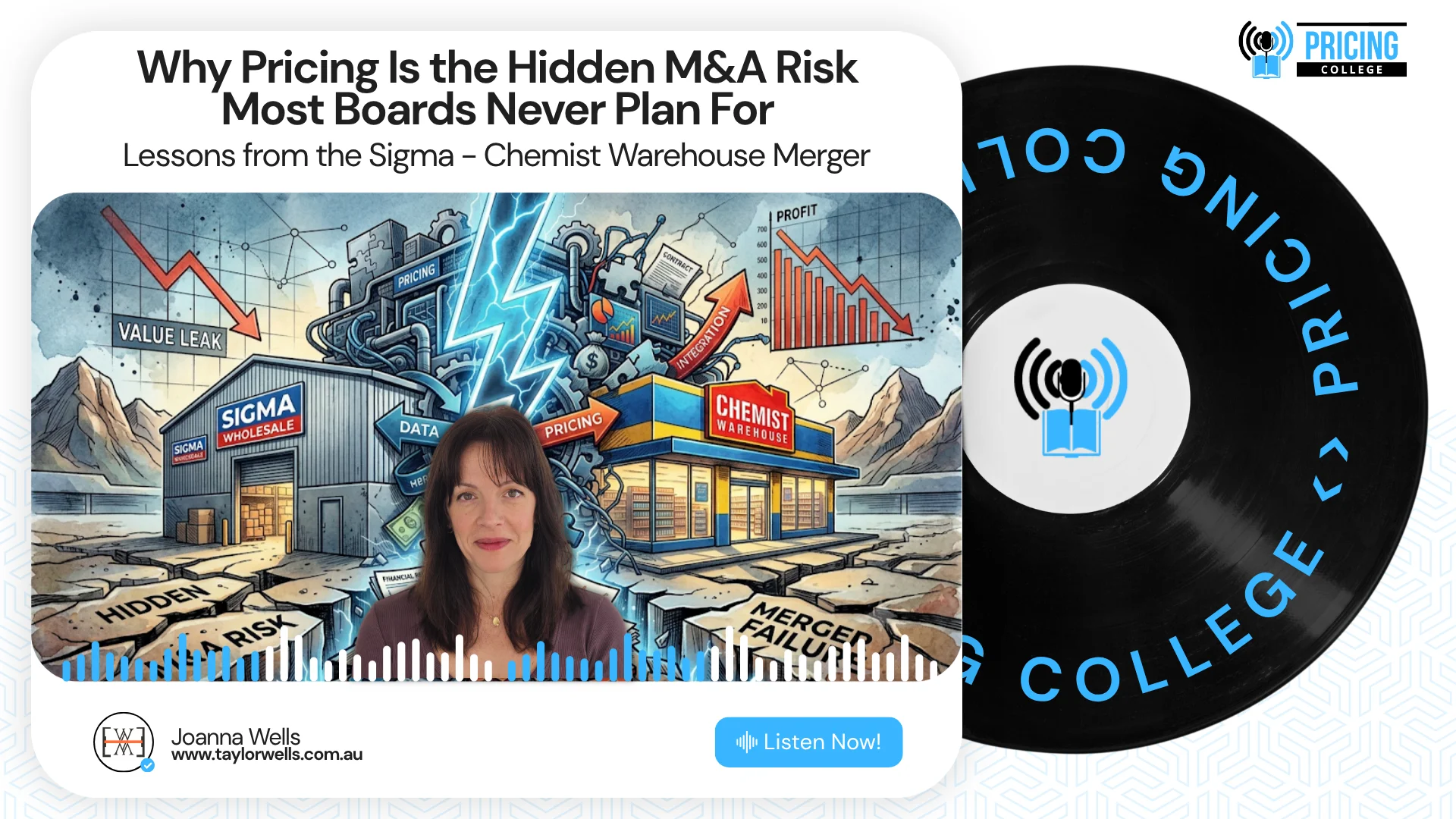
Joanna Wells explores why a strong pricing framework is often the missing link in successful mergers and acquisitions, using the Sigma–Chemist Warehouse merger to reveal the hidden pricing risks that can undermine promised synergies.
This episode examines how businesses can rebuild their pricing framework through a robust pricing architecture model, helping leaders close the pricing integration gap, protect margins, and make pricing decisions that are transparent, defensible, and commercially sustainable.
TIME-STAMPED NOTES:
[00:00] Why Every Merger Needs a Strong Pricing Framework
[01:53] The Pricing Framework Gap Behind Failed Merger Synergies
[03:24] How a Pricing Architecture Model Supports Vertical Integration
[05:25] Why Legacy Pricing Frameworks Fail After Mergers
[07:10] Conclusion: Rebuilding Your Pricing Framework After an Acquisition
Why Every Merger Needs a Strong Pricing Framework
[00:00] In November, 2024, the ACCC approved the Sigma Chemist Warehouse merger. On paper, it looked like another major acquisition: a wholesaler, a retailer, bigger scale, more buying power, more customers. But mergers like this create a commercial problem that rarely makes the headlines: pricing, because when two businesses become one, their pricing architectures don’t automatically merge with them.
[00:34] Every merger is sold on synergies, better buying power, higher margins, lower costs, stronger commercial performance. Then 18 months later, the board asks the same question: where are the synergies we paid for? Imagine standing in front of your board two years after a multi-billion dollar acquisition.
[00:59] Revenue is up. Integration is largely complete, yet the margin uplift in the investment case never arrived. Everyone starts looking for the leak. Procurement blames operations. Operations. Blame sales. Sales blames the market. Almost nobody asks whether pricing was ever rebuilt for the businesses they created.
[01:25] The answer is often hiding in plain sight. The businesses merged. The pricing didn’t. From that day forward, value began leaking out through pricing decisions. No one had redesigned. Most boards never see it that way. They attribute the shortfall to integration, complexity, market conditions, and timing, but the real explanation is simpler and more expensive.
The Pricing Framework Gap Behind Failed Merger Synergies
[01:53] Here is a gap between the commercial structure of the business that was acquired and the pricing architecture of the business that now exists. I call it the pricing integration gap. It’s where promised merger synergies quietly disappear. So Sigma, for example, the undertakings Sigma gave the ACCC to secure merger approval are all in a public document.
[02:22] This episode is about what happens when you read those types of undertakings as a commercial pricing brief instead of a legal document. Three conditions really stood out for me. First, wholesale customers must be free to switch suppliers. Second, customer data must be deleted when they do, and third, rural and remote pharmacy supply must be protected until 2030.
[02:52] Now, on the surface, they look and read like legal conditions, but read them with a different lens. Read them commercially, and you can see that they reveal three pricing risks. Customer lock-in pricing, data, supply dependency. Those aren’t just legal safeguards. They’re three areas where pricing and commercial decisions become critical in any vertically integrated business.
How a Pricing Architecture Model Supports Vertical Integration
[03:24] So let’s keep with this Sigma case study because it really shows what vertical integration actually means for pricing. So Sigma now runs a wholesale business and a retail business inside the same structure. Its wholesale arm sells stock to independent pharmacies. Its retail arm chemist warehouse competes against those same pharmacies for the same customers.
[03:51] Every pricing decision made in the wholesale arm affects what the retail arm is competing against. Generous wholesale pricing. Its retail arm faces stronger competition, tighter wholesale pricing; the retail arm benefits, but the wholesale customers notice, and the regulator is watching too. So this tension plays out in daily commercial decisions.
[04:16] Who gets what price and what terms with what justification. Most businesses that go through vertical integration don’t really build a framework to manage this type of conflict. They let it happen by almost default to teams to objectives and no shared pricing architecture. The second condition that I mentioned earlier, the data deletion on switch exists for a specific reason.
[04:44] When your wholesale and retail operations sit inside the same business, data flows between them; your wholesale arm knows exactly what every independent pharmacy is buying, their margins, their volume, their bestselling lines, how price sensitive or not they are.
[05:02] Now, if that data informs retail pricing decisions, even indirectly, that is the risk that a CC named, not because anyone set out to misuse it, but because without a clear rule about what data can and cannot cross between the two arms, wholesale and retail, it finds its way in.
Why Legacy Pricing Frameworks Fail After Mergers
[05:25] But there is a fourth issue the undertakings don’t address, not because it isn’t important, but because it sits inside the business itself. And that’s pricing integration. The ERP gets integrated, finance gets integrated, procurement gets integrated, HR gets integrated. Pricing usually doesn’t. Legacy price list, survive legacy discount structure, survive legacy.
[05:55] Customer agreements survive. Two. Commercial philosophy survives. The organisation looks integrated. The pricing architecture isn’t; that is the pricing integration gap. Pricing is usually one of the last commercial capabilities to be redesigned after a merger because everyone assumes the existing model will cope.
[06:24] It may do until the promised margin improvements never arrive. This is not a problem you solve by tweaking the existing model. It’s a transformation. The pricing architecture that served the simpler business needs to be rebuilt for the commercial reality of the new one. Data flows between the wholesale and retail arms.
[06:49] They need to be deliberately designed, not discovered after the fact. And the pricing decisions that were once made independently now need to be made within a single commercial architecture. That’s not a compliance exercise; it’s a commercial imperative.
〉〉〉 Get Your FREE Pricing Audit 〉〉〉
Conclusion: Rebuilding Your Pricing Framework After an Acquisition
[07:10] So I want to ask you one question. If the ACCC asked you to show that the pricing decisions in your wholesale arm over the last 12 months didn’t disadvantage your wholesale customers in order to benefit your retail arm and customers, could you prove it not with a claim or assertion, but with a pricing architecture that makes every decision visible, documented, and defensible?
[07:38] Could you prove it? Every merger promises synergies. Very few rebuild the pricing architecture needed to deliver them. That is where margin quietly disappears. The Sigma Chemist Warehouse merger is a visible, documented, and publicly approved version of this problem.
The ACCC conditions tell you exactly where the pricing risk lives, but most businesses read those conditions just as a legal obligation.
[08:12] But the ones who read them as a commercial pricing brief are probably the ones asking the right question after an acquisition. Not just, uh, where are the synergies, but have we closed the pricing integration gap effectively? The Sigma Chemist Warehouse merger is the most visible version of this in Australia right now, but it’s not the only one.
[08:39] Any business that’s gone through a major acquisition, any business where two commercial structures now sit inside the same entity, is navigating this pricing integration problem.
[08:52] The ones who address it deliberately will capture the margin, the merger promise; the ones who don’t will probably spend years trying to recover value that was lost the day the pricing architecture stood still whilst the business changed, and not because the acquisition was wrong, but because the pricing architecture was never rebuilt for the business they created.
Read This CEO Pricing Strategy To Improve Margin Management & EBIT
Are you a business in need of help aligning your pricing strategy, people, and operations to deliver an immediate impact on profit?
If so, please call (+61) 2 9000 1115.
You can also email us at team@taylorwells.com.au if you have any further questions.