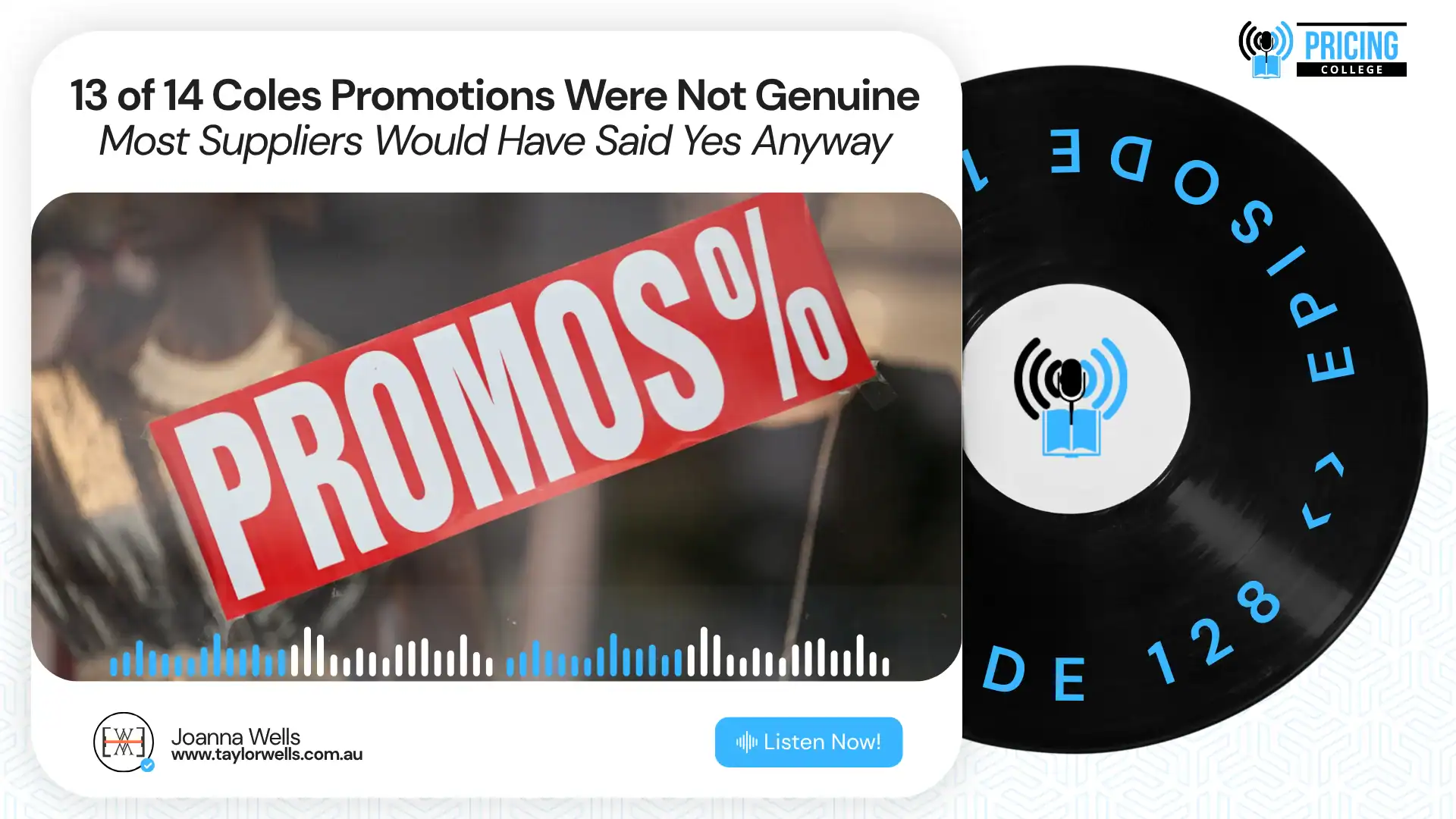
Joanna Wells explores the lessons FMCG suppliers can take from the Coles court case. The ruling highlights how weak pricing and promotion discipline can gradually erode margins, increase dependence on major customers, and weaken a supplier’s ability to defend value.
This episode examines how years of promotional funding, discounting, and commercial concessions become embedded in customer relationships. It also explores why businesses with a clear value position are better able to hold their ground, while those without one often find themselves negotiating away profitability.
TIME-STAMPED NOTES:
[00:00] Introduction: What Happened at Coles
[00:47] The Coles Case and the Real Pricing and Promotion Problem
[02:01] When Pricing and Promotion Concessions Become Permanent
[03:35] The Pricing and Promotion Advantage Strong Suppliers Have
[05:30] Can Pricing and Promotion Survive Retailer Pressure?
[07:14] Four Pricing and Promotion Risks Most Businesses Ignore
[08:53] Conclusion: Building a Defensible Value Position
What Happened at Coles
00:00 Two weeks ago, the Federal Court handed down its verdict against Coles. 13 of 14 Down Down promotional products were examined. And the discount wasn’t genuine. Coles had temporarily inflated the price of each product, then promoted the markdown as a saving. The court found consumers were misled.
00:22 The Woolworths case is currently before the Federal Court in Melbourne right now. Same allegation, products include Tim Tams, Oreo, and Kleenex. Prices raised for weeks, then prices dropped to a price still higher than where they started. Your category almost certainly has products in that picture.
The Coles Case and the Real Pricing and Promotion Problem
00:47 Now, here is what these cases reveal. Not about the retailers, but about the suppliers behind the products. Coles’ defence in court argued these price increases were driven by genuine supplier cost pressures. The court rejected it. But it put supplier pricing, your pricing, into the commercial and legal spotlight in a way the industry didn’t expect.
01:15 For years, suppliers allowed retailers to control the price story of their own products. And in many cases, not because they believed in the return, but because they appeared to lack a value position strong enough to hold. That’s not a retailer problem; that’s a pricing discipline problem. And your sales team is having a version of that same conversation with your customers this month, without knowing what it’s actually costing you.
01:45 When FMCG leaders see what just came out of the Federal Court, most of them ask the same question: Is our retailer relationship at risk? That’s the wrong question, and this is why.
See whether your pricing is under control
When Pricing and Promotion Concessions Become Permanent
02:01 Most of these promotional funding arrangements were not demanded from suppliers overnight. They were agreed to, one concession at a time. The rate felt manageable, the relationship felt worth protecting. Nobody modelled what happened when this year’s promotional rate became next year’s baseline. And by the time that cost becomes visible, the margin erosion, the promotional escalation that never reverses, the revenue from the retailer is load-bearing. You cannot exit without a plan. And building a plan requires the commercial rigour that was never applied when each concession was made.
02:46 So the right question is not whether the relationship is at risk, it is if a major customer came to you tomorrow and pushed for a 15% promotional discount, does your commercial team have a position to hold? Not a gut feel, not a negotiation instinct, a precise, value-based commercial position.
03:11 Most commercial teams don’t have that. They have a relationship, they have a margin they’re trying to protect, but they don’t have a number grounded in commercial value. So they negotiate down. The retailers who push hardest found the suppliers without a floor. Most of these suppliers still don’t have one.
The Pricing and Promotion Advantage Strong Suppliers Have
03:35 The suppliers that appeared better able to hold prices weren’t necessarily the biggest. In many cases, the biggest conceded the most. The ones who held the price had one thing the others didn’t. They knew precisely what their product delivered to the category in commercial terms, in margin terms, in consumer terms. They had a value position that their leadership team could defend. They had a floor.
04:05 Many of those who kept funding promotions appeared not to have that. They had a margin they couldn’t defend and relationships they couldn’t afford to lose. So they traded one for the other. In many cases, the margin pressure became structural. One number, a precise commercial value position. That was the difference between holding price and capitulating. Most FMCG businesses have never built that number. And without it, they couldn’t hold. They could only agree.
04:44 How many promotional funding conversations has your commercial team had this year? And in how many of them did they have a number to defend?
04:54 Value-based pricing is not a philosophy. It’s a commercial defence. When you know precisely what your product delivers to the consumer, to the retailer’s category, you have a position. When you discount away from that position, you know exactly what you’re trading and why. When you don’t have that position, every promotional request is a negotiation you’ll lose because the customer always knows their number. The question is whether you know yours.
Can Pricing and Promotion Survive Retailer Pressure?
05:30 Now, the pushback most suppliers give at this point is fair. The market doesn’t give us much pricing power. When two retailers control the shelf, a value floor feels theoretical. That is real commercial pressure. It deserves to be taken seriously. But here’s what that argument actually reveals. It reveals that your pricing position is entirely determined by what the retailer will accept, not by what your product delivers to the consumer. That is precisely the exposure.
06:08 The same dynamic plays out for suppliers going through any concentrated channel: grocery, hardware, trade, retail. When one buyer controls significant category share, the structural pressure is identical. The suppliers that appear to hold price in those markets aren’t out-muscling the buyer. They built a commercial position grounded in genuine consumer value: demand, category performance, brand equity. A floor the retailer had commercial reasons to respect. Most FMCG suppliers have never built that case. Not because it doesn’t exist, because nobody showed them where to start. The ones that hold price in concentrated markets didn’t fix everything at once. They started with the promotional terms and discount structure they could actually defend, and built the pricing architecture outward from there.
See how pricing breaks in practice
Four Pricing and Promotion Risks Most Businesses Ignore
07:14 There are three ways discounting without a value position destroys commercial outcomes. First, the promotional ask escalates every year. There is no floor to push back from so the ask grows. This year’s promotional rate becomes next year’s baseline. Your sales team calls it relationship investment, your P&L calls it margin erosion.
07:40 Second, category reviews become price auctions. Without a clear value story, you compete on discount. The customer wins that conversation every time because they have a position, and you have a precedent.
07:56 Third, you hold volume and lose margin, and the reporting never shows it clearly. Revenue looks stable, the commercial team hit their numbers. Three years later, someone looks at the actual margin per customer and finds the loss. By then, it has compounded.
08:15 And there is a fourth consequence that doesn’t appear in your commercial reporting at all. Every time your product runs at a promotional price, real or manufactured, the consumer recalibrates what it is worth. The Federal Court just confirmed that consumers were misled about the genuine value of branded products. Discount dependency doesn’t just erode margin; it erodes brand trust. All four are running inside businesses with healthy-looking top lines right now.
〉〉〉 Get Your FREE Pricing Audit 〉〉〉
Conclusion: Building a Defensible Value Position
08:53 The Federal Court just handed FMCG suppliers something they rarely get: a public verdict on what promotional pricing looks like when there is no genuine value anchor behind it. 13 of 14, not genuine. The lesson isn’t about what those retailers did; it’s about what your business would do if a major customer pushed just as hard. Do you have a value position clear enough to hold, or would your commercial team negotiate down to protect the relationship? Most businesses never build a value position, so they discount instead. Price is a position. Most businesses treat it as an opening offer.
Read This CEO Pricing Strategy To Improve Margin Management & EBIT
Are you a business in need of help aligning your pricing strategy, people, and operations, and margin management to deliver an immediate impact on profit?
If so, please call (+61) 2 9000 1115.
You can also email us at team@taylorwells.com.au if you have any further questions.