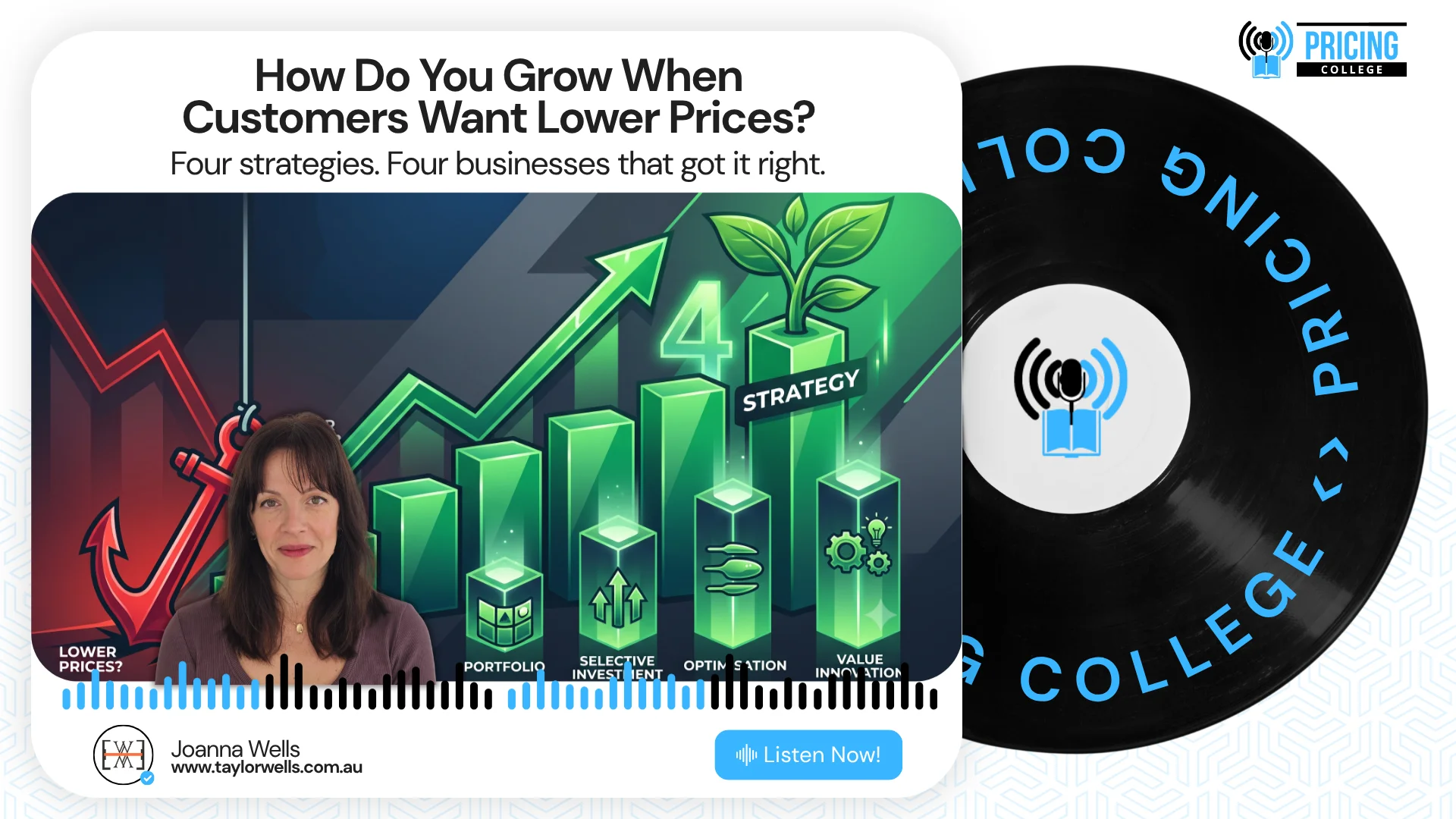
Joanna Wells explores how customer value pricing helps businesses grow when customers ask for lower prices, using real-world examples from Penfolds, Woolworths, Nestlé and John Deere to show why discounting is rarely the best solution.
This episode examines four proven customer value pricing strategies that help business leaders protect margins, strengthen value, and achieve sustainable growth without competing on price.
TIME-STAMPED NOTES:
[00:00] Why Customer Value Pricing Beats Lower Prices
[01:31] Portfolio Strategy: Customer Value Pricing in Action
[04:21] Selective Price Investment: Customer Value Pricing That Works
[05:57] Portfolio Optimisation: Customer Value Pricing for Higher Margins
[07:31] Value Innovation: Pricing Beyond Discounts
[12:08] Conclusion: The Four Customer Value Pricing Strategies That Drive Growth
Why Customer Value Pricing Beats Lower Prices
[00:00] I had a CEO ring me a few weeks ago. It was a big business, good team, and he said, my biggest customer just told me that they need us to lower our prices. What do I do? So every CEO knows what comes next. If you say yes, margins fall. If you say no, you might lose the customer. And that’s the trap. Every CEO eventually faces this moment.
[00:24] There isn’t an obvious right answer. Whatever you do, something important is at risk. This episode is about the businesses that found a way through. Now, I thought I’d just start with a recent news article that I read, and it was in regards to Penfolds, who in this month released that annual wine collection.
[00:47] And when I read the release, one thing really jumped out for the first time in two decades, not a single wine actually went up. Their flagship, which has Grange at a thousand dollars a bottle, has been at the same price for five years running. Now, when you factor in inflation, that means it’s actually cheaper in real terms than it was in 2018.
[01:09] The premium wine market has been really tough. Customers are easing back now, but they’re spending less in trading down. The Penfolds has grown not because they’ve lowered their prices, because they had an answer to the question. How do you grow when customers want lower prices? Four strategies, four businesses that got it right.
Portfolio Strategy: Customer Value Pricing in Action
[01:31] Three of them that have never lowered a single price, one that did, but only where it counted most. Portfolio strategy, selective price investment, portfolio optimisation, value innovation. Let me take you through each one. Strategy one portfolio. How can you grow when customers want lower prices? Before I show you what Penfolds did with their portfolio, let me show you how I’ve seen this play out with one of my own clients.
[02:05] It was a large industrial supplier. One of the biggest customers was Bunnings. And for years, every time Bunnings pushed for a lower price, they gave one. When we looked at two years of data across all channels, we found that every discount Bunnings had extracted had become the reference price for every other channel.
[02:27] If Bunnings was paying that, why should anyone else pay more? The whole portfolio had been dragged down. Premium products, barely sitting above Ks, years of saying yes to one customer had been basically eroding prices across the entire business, across all channels.
So what we did, we redesigned the channel and portfolio framework and gave the team a way to hold their position instead of reacting.
[02:57] Every time a customer pushed for a discount, Penfolds faced exactly the same dilemma, but they solved it in a different way. When customers in their premium market started pulling back, most wineries discounted their best bottles. They dropped the price to hold on to customers to protect volume. But once you discount your premium products, it’s very difficult to ever earn that price back.
[03:26] Your customers, remember the lower price? Your salespeople use it in every negotiation. Customers stop believing it’s worth the premium. Felds held the premium bottle Grange at a thousand dollars. They invested hard in the most affordable end of the range. The $55 bottles of wine are getting some of the best reviews in this year’s collection.
[03:52] So the customers who can’t spend a thousand dollars this year on a bottle of Grange don’t walk away from Penfolds. Full stop. They buy the $55 bottle of wine and they’re happy. They stay in their brand and they’re happy with the product. And that’s how Penfolds grows when customers want lower prices, not by lowering the premium, by making sure that an excellent product at every price point is available in their range.
Selective Price Investment: Customer Value Pricing That Works
[04:21] Strategy two, selective price investment. And for this, I’d like to give Woolworths as a case study of how you grow when customers want lower prices. Woolworths’ answer is to be smart about which prices you lower, because most of your customers will barely notice why, because they’re not watching those products in the first place.
[04:46] They tend to be watching the price of their favourite products. When I work with retailers, one of the first things I ask is, which products are customers actually watching? Not all products, not even most products. There are usually a handful of products in any range that customers actually price check.
[05:06] The rest they barely notice. Allworth knows exactly which products we’re all watching. Things like eggs, bread, nappies. A few weeks ago, they froze prices on 300 specific products. The things every shopper notices, checks, remembers at the end of the week, everything else held. So Woolworths didn’t say yes to lower prices.
[05:31] Across the board. They said yes to lower prices on the products. Every customer is watching the margin they gave up on eggs, they protected everywhere else. That’s how Woolworths grows when customers want lower prices by winning on the products that matter and holding on the ones that don’t. Strategy three, portfolio optimisation.
Portfolio Optimisation: Customer Value Pricing for Higher Margins
[05:57] And for this, I’d like to give Nestlé as my case example of how you grow when customers want lower prices. Now, Nestlé’s answer is the one most boards don’t like very much, or maybe even refuse to consider. They say leave. I ask CEOs all the time, which products or categories would your business be better off without?
[06:21] Almost none of them have an answer ready for this. Boards hate walking away even when staying is destroying value. Even when the category is highly commoditised, the margin is gone and every conversation with the customer is about price. Boards still don’t want to let it go, but Nestlé did let it go over 400 brands reducing to approximately 150 selling ice cream, selling water, getting out of coffee retail, not because those are like bad businesses or categories, but because Nestlé looked at them and made an executive decision that most companies won’t.
[07:04] They said, we cannot win on value here, so we’re leaving. And they’re putting everything else into health, nutrition, functional beverages, categories where customers still believe the price is worth it. Now, that’s how Nestlé grows. When customers want lower prices, they stop fighting the categories where they’ve lost and put everything into the ones where they think they can still win.
Value Innovation: Pricing Beyond Discounts
[07:31] Strategy for value innovation, and for this, I’d like to give John Deere as a case example of how do you grow when customers want lower prices? Now, John Deere’s answer is the one I’d like to spend the most time on, and I often use it with my clients because it applies to almost any business no matter what you sell.
[07:54] So let me just set the scene. John Deere sells farming equipment. Big machines, half a million dollars each. Their customers are farmers. And farmers right now are under serious margin pressure. The cost of running a farm has gone up so much with fuel, labour costs, fertilisers. So every John Deere salesperson is sitting across from customers saying, we love your equipment, we love the business, but with everything going on, can you do something on the price?
[08:26] Most businesses in that position would start dropping prices, but John Deere hasn’t. They ask a different question, not how do we make our machines cheaper, but how do we make our customers more profitable?
Here’s what they’ve changed. John Deere used to sell machines. A farmer bought a machine, they used it, they traded it in, bought another one.
[08:55] John Deere made their money on the sale. The parts, the maintenance. That was the whole business. That model still exists, but alongside it, John Deere has built something completely different. They put sensors, GPS connectivity inside every machine. All of that data feeds into a platform that tells a farmer in real time, exactly what their farm needs, where to plant, where to add fertiliser, where to spray for weeds, and where not to.
[09:30] They even have cameras on the machines now that can identify a weed from a crop. As the machine moves across a field, it only sprays the weed. Farmers using that system are reducing their weed spray costs by up to 77%.
A farmer buying a John Deere machine today isn’t just buying a better machine than they did five years ago.
[09:55] They’re running their farm completely differently. Their costs are lower. The output is much more precise. The half-million-dollar machine pays for itself in a way it simply didn’t before. And on top of the machine, John Deere now sells software subscriptions, things like data services, connectivity, tools that keep improving every year revenue from every machine in the field.
[10:22] Every single year. The farmer isn’t buying a harvester anymore. They’re buying a productivity platform for their farm. That’s how John Deere grows. When customers want lower prices, they change what the price buys. The machine didn’t get cheaper, the farmers got more profitable, and when a customer can see exactly what they’re getting for their money, the whole conversation changes.
[10:53] So I want to ask you something I ask almost every CEO I’ve worked with. When a customer comes to you asking for a lower price, have you actually stopped to work out? Why not?
The reason they gave you the real one, because most of the time when a customer asks for a lower price, they’re not just asking for a lower price.
[11:17] They’re asking you to show them the value. If the only answer you’ve got is a lower price, you’ve already lost the conversation. Penfolds worked it out and made every price point in the range worth buying. Woolworths worked it out and knew exactly which 300 products were driving trust. Nestlé worked it out and made the call.
[11:43] Most boards won’t. John Deere worked it out and rebuilt what the product does for the customer. Most businesses don’t ask the question, they just lower the price, and then they wonder why the margin never comes back. I had a CEO ring me a few months back. My biggest customer wants us to lower our prices.
〉〉〉 Get Your FREE Pricing Audit 〉〉〉
Conclusion: The Four Customer Value Pricing Strategies That Drive Growth
[12:08] What do I do? There’s no single answer to that, but there are different strategies. Today I’ve discussed portfolio-selective price investment, portfolio optimisation, and value innovation. These are four strategies, four different answers to the same question. None of them lower the price and hope for the best.
[12:33] The businesses that figured this out are all still growing. The ones that didn’t are still discounting. Customers will always ask for lower prices. That is something that is never going to change. Businesses that don’t figure this out, keep giving away margin, they’ll never get back. The businesses that grow aren’t the ones with the lowest prices.
[12:58] They’re the ones with the best answer. What’s yours? I’m Joanna Wells. I’ll see you next week.
Read This CEO Pricing Strategy To Improve Margin Management & EBIT
Are you a business in need of help aligning your pricing strategy, people, and operations to deliver an immediate impact on profit?
If so, please call (+61) 2 9000 1115.
You can also email us at team@taylorwells.com.au if you have any further questions.