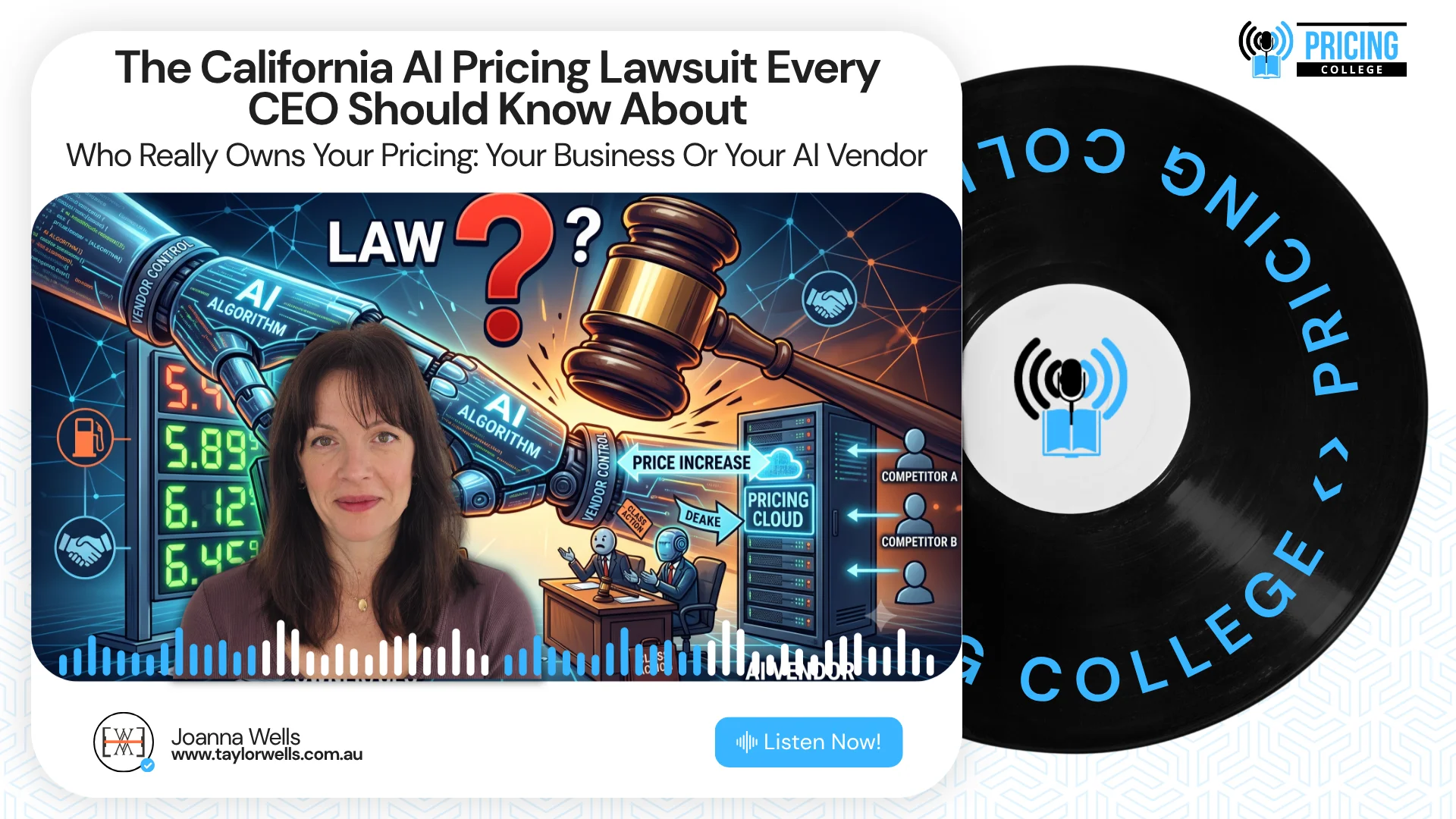
Joanna Wells explores why AI and dynamic pricing are raising critical questions about who really controls pricing decisions as businesses rely more on algorithms and third-party vendors.
This episode examines the legal and commercial risks of delegating pricing decisions to AI and explains why CEOs must keep pricing strategy accountable, transparent, and aligned with customer value.
TIME-STAMPED NOTES:
[00:00] The Hidden Risks of AI and Dynamic Pricing
[01:44] How AI and Dynamic Pricing Can Influence Market Competition
[05:17] When AI and Dynamic Pricing Take Control Away from Businesses
[08:13] Why AI and Dynamic Pricing Require Stronger Governance and Accountability
[11:38] Conclusion: Who Really Controls Your Prices?
The Hidden Risks of AI and Dynamic Pricing
00:00 Today’s episode discusses allegations made in a recently filed lawsuit. The matter remains before the court, and no findings have been made.
00:12 Your pricing algorithm changed 12,000 prices last night. Could you prove they were right? Most CEOs cannot answer that question, and most assume it doesn’t even matter. The algorithm is running, revenue is coming in, the vendor says it’s working. But on the 22nd of June, 2026, eight of the largest fuel retailers in the United States discovered that assumption has a price.
00:44 On the 22nd of June, 2026, a federal class action was filed in the Eastern District of California. The defendants include Marathon, Circle K, BP, Speedway, EG America, Walmart, Albertsons, and 7-Eleven. Together they operate more than 1,700 gas stations across the state. The lawsuit alleges illegal price coordination. None of them met to agree on a price, none of them called each other, none of them sent an email, signed a document, or made a handshake deal. They all subscribed to the same pricing software, a platform called Kalibrate. According to the complaint, the combination of using the same platform and the way it allegedly operated formed the basis of the claim.
How AI and Dynamic Pricing Can Influence Market Competition
01:44 This is where I want to spend some time. Not on the legal outcome, that’s not been decided yet, but on the pricing mechanism the complaint describes, because the mechanism is worth understanding precisely. Kalibrate sells a product called Kalibrate Fuel Pricing. It connects a station’s pumps and price signs to a central platform the company calls the Pricing Cloud. That platform pulls data from more than 6,000 sources. So, some of those sources are public, competitor prices that are visible at the pump and available market data.
02:26 But some are not public. And according to the complaint, they are the cost and volume figures that Kalibrate’s own customers submit directly to the platform. So things like proprietary business data from competitors flowing into the same system, generating recommendations that go back to all of them. The complaint also cites Kalibrate’s marketing material stating that customers could delegate up to 90% of their pricing decisions to the algorithm. 90%! According to the complaint, eight of the top 10 US fuel retailers use the platform.
But they never handed over the definition of a good price. Or did they?
03:16 Let me try to describe this in simple terms. Imagine every petrol station on a strip subscribed to the same app. Every morning, the app sends each one a recommendation: “Here is what every other station near you is charging today. We suggest you price here. And if you’re thinking about going lower, don’t. We have seen what happens, everyone chases the bottom and nobody wins.”
03:46 So now imagine that same app has a button. When prices in an area have fallen too low, any station can press it. The app then notifies every other subscriber in that market a price recovery has started: “Join it right now, together.” No phone call, no meeting, no handshake. And according to the complaint, that is how the restoration tool was allegedly operating. And when 1,700 stations are all reading the same app, following the same recommendations, and joining the same price recoveries, the market stops competing. Not because anyone specifically directed it to, because everyone followed the same instructions.
04:34 So, according to the complaint, the platform Kalibrate didn’t merely observe the market. It became the mechanism through which competitors allegedly moved together. The issue isn’t that Kalibrate uses competitive pricing data. Most sophisticated pricing systems do that. Competitor intelligence is a legitimate input. The issue alleged in the complaint is what happens when competing businesses feed commercially sensitive information, their own non-public cost and volume data, into the same system and then delegate the majority of their pricing decisions back to that same system.
When AI and Dynamic Pricing Take Control Away from Businesses
05:17 The defendants deny the allegations, and the matter is yet to be determined by the courts. The result, if the allegations are proven, is that 1,700 stations were not independently setting prices. They were all receiving instructions from the same platform. And when every participant follows the same platform’s instructions, the platform is not reading the market anymore. It’s reading itself. Every station pricing off every other station through the same system in a loop. Pricing is moving not because demand has changed, not because supply has changed, not because anything in the underlying economics has changed, but because the algorithm recommended they stay in formation.
And the retailers who subscribed to that platform called it their AI pricing strategy.
06:17 The complaint points to research estimating that algorithmic fuel pricing systems can increase prices by approximately 6 cents per gallon on average, and by as much as 30 cents in markets where adoption is concentrated. California burns 13.4 billion gallons of fuel a year. At 1 cent per gallon just 1 cent, that is 134 million annually to consumers.
06:51 Now, I want to ask a different question. Not just about the numbers and the costs. About the people inside those organisations who are accountable for pricing. How many of them understood the mechanics of what they had subscribed to? Did they understand how the algorithm generated its recommendations or the role different data inputs play? Did they know their non-public cost and volume data was flowing into a shared platform alongside their competitors’ data? And did they even understand what the restoration tool was designed to do? These are not rhetorical questions. These are the questions that determine where accountability sits.
07:38 Now, I’m sure that the executives who signed these subscriptions weren’t trying to hand over control to AI. They were buying speed and scale. They expected the algorithm to execute faster, to be more precise than a human team could. I’m sure they fully expected to retain the strategy, the commercial judgment, the accountability. That is a reasonable expectation. It is also how AI platforms are commonly positioned, automate execution while leaving strategy and governance with the business.
Why AI and Dynamic Pricing Require Stronger Governance and Accountability
08:13 However, the question the Kalibrate complaint raises, not yet settled by any court, is whether the objective embedded in the algorithm became the de facto pricing strategy for 1,700 stations. Not because anyone intended that, because nobody explicitly governed against it. Your vendor’s definition of success: the platform runs, prices are generated, stations are subscribed, the algorithm is executing. Your business’s definition of success: the price is right, customer-focused, profitable, defendable, explainable to customers, a regulator, and your own board.
09:08 Now, imagine asking your pricing vendor one simple question: “Why did the algorithm increase this customer’s price by 7.3% yesterday?” If the answer starts with “because the model determined” instead of “because your pricing strategy says,” you have already lost control. The technology is explaining itself. It may no longer be explaining your business, your strategy. When those two definitions diverge, when the platform is running perfectly while the price is legally or commercially wrong, the question of who is responsible does not have a clean answer. Not in the boardroom, and increasingly, not in the courtroom.
09:56 Most CEOs adopting AI pricing technology ask things like: “Will this make my life easier, my team’s life easier? Will we be able to get better prices, more profitable prices, and safely? Will this disrupt our business?” But almost no one is asking the question: “Better by whose definition?” Because algorithms don’t decide pricing, they execute objectives. The danger is not that the algorithm chooses the objective, it’s that someone else does, and that no one in this instance seems to know who. The calculation isn’t where the risk lives.
The objective is, because the objective decides the price.
10:41 Protect margin, match the market, avoid being undercut, prevent a downward spiral, maximise revenue. Each objective instruction produces a different price. Each objective instruction or rule creates a different risk. And somebody inside the business must decide which objective the algorithm is authorised to pursue. That decision cannot belong to the vendor. CEOs don’t buy AI to outsource judgment; they buy it to automate execution. The danger is not what they intended to delegate, it’s what they delegated without realising. The Kalibrate complaint, whatever the outcome is in court, makes that invisible delegation visible. And once you see it, you cannot unsee it.
〉〉〉 Get Your FREE Pricing Audit 〉〉〉
Conclusion: Who Really Controls Your Prices?
11:38 So I want to leave you with the same question I opened with. Your pricing algorithm changed 12,000 prices last night. Could you prove they were right? And if a regulator, a customer, or your own board asked you to defend every one of those prices, would the answer be in your system, or in the pricing cloud of a vendor you subscribed to three years ago? Because those are not the same place. And the difference matters more than most CEOs currently understand.
12:13 The next generation of CEOs will not be judged by whether they adopt AI. They will be judged by whether they still understood their business after they did. Because the companies that win will not have the smartest algorithms, they will have the strongest governance behind them. Technology does not create pricing strategy. People do.
Read This CEO Pricing Strategy To Improve Margin Management & EBIT
Are you a business in need of help aligning your pricing strategy, people, and operations to deliver an immediate impact on profit?
If so, please call (+61) 2 9000 1115.
You can also email us at team@taylorwells.com.au if you have any further questions.